
How to use › Technical Bulletin
Nanocyn Advanced is a ready-to-use, pH-neutral, hospital-grade hard surface disinfectant, sanitiser and cleaner. Here is a summary of its Technical Bulletin, in plain English.
Download Technical Bulletin (PDF)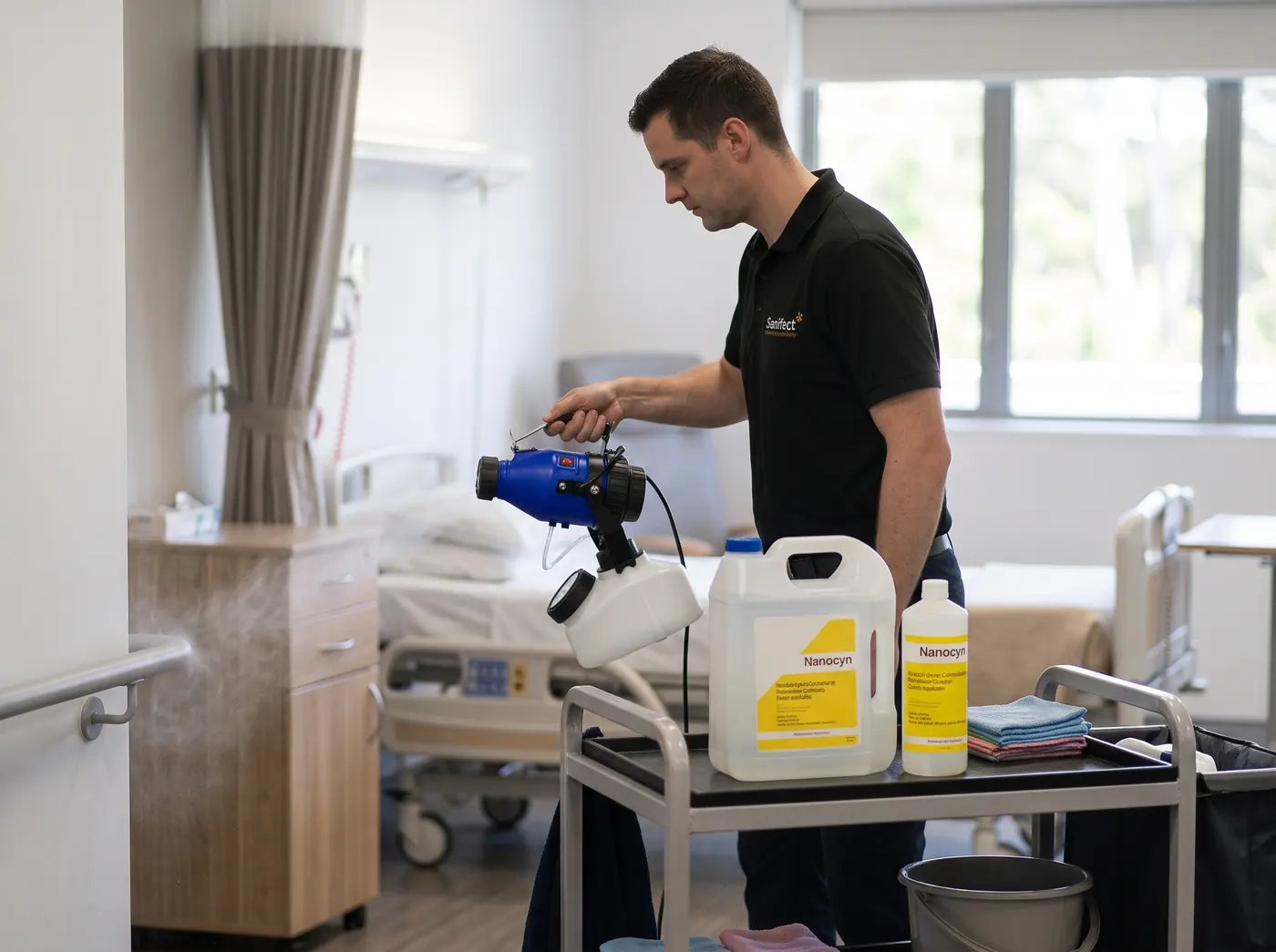
About the bulletin
Nanocyn Advanced is a ready-to-use, pH-neutral, broad-spectrum, hospital-grade hard surface disinfectant entered on the Australian Register of Therapeutic Goods as AUST L 520725. Listed efficacy covers Gram-positive and Gram-negative bacteria, yeasts, fungi and mould, and enveloped and non-enveloped viruses, including Clostridium difficile, Candida auris, Norovirus and SARS-CoV-2.
It has a neutral pH of approximately 7. It is not classified as hazardous under the model WHS Regulations and GHS (Revision 7), is not a Dangerous Good, is not a Scheduled poison, has no signal word or pictogram, and requires no PPE under normal conditions of use.
Highlights from the bulletin: Norovirus and Poliovirus in 30 seconds; SARS-CoV-2 (COVID-19) in 15 seconds, the fastest contact time on the AUST L 520725 entry; Candida auris and Clostridium difficile, both named on the AUST L 520725 entry, in 10 minutes. It is listed for spray and wipe, misting, fogging, ULV and electrostatic application, with no dilution and no rinse.
Key facts
Format and pH
Ready to use. Do not dilute. No rinse. Neutral pH, approx. 7.
Pack sizes
500 mL, 990 mL and 5 L
Listing
AUST L 520725. Active, start date 21 November 2025
Hazard classification
Not classified as hazardous under the model WHS Regulations and GHS (Revision 7). Neutral pH, approx. 7
Poisons standard
Not scheduled (SUSMP)
Transport
Not a Dangerous Good under the ADG Code, IATA or IMDG
Sponsor of AUST L 520725: MicroSafe Care Australia Pty Ltd. Therapeutic goods category: listed disinfectant, hospital grade (GMDN 9950).
Microbiological efficacy
All organisms and contact times are as entered on AUST L 520725. Contact time is the period the treated surface must remain wet. The bulletin ranks the classes from most to least resistant to chemical disinfection.
Norovirus (Gastro) and Poliovirus. The most resistant viral class.
30 seconds
Trichophyton mentagrophytes (Tinea) and Candida auris
10 minutes
Clostridium difficile, Escherichia coli and Pseudomonas aeruginosa
10 minutes
SARS-CoV-2 (COVID-19) in 15 seconds, the fastest contact time on the AUST L 520725 entry. Herpes Simplex Virus in 30 seconds.
SARS-CoV-2: 15 seconds. Herpes Simplex: 30 seconds.
Clostridium difficile and Candida auris are both named on the AUST L 520725 entry. Efficacy claims are those entered for AUST L 520725.
Where and how
If soil remains after treatment, remove it and reapply. Do not mix with products containing ammonia. Not to be used on medical devices or other therapeutic goods.
Safety and care
Appearance: clear, colourless liquid, minimal odour. pH neutral, approx. 7. Relative density 1.0 (water = 1). Completely soluble in water. Flash point: none, will not burn.
Approvals
This page is a plain English summary. The Technical Bulletin is the full reference.
Download Technical Bulletin (PDF)Always read the label and use as directed.
Talk to our team about how Nanocyn Advanced fits your site.